
"I have been a happy man ever since January 1, 1990,
when I no longer had an email address."
-
Donald Knuth
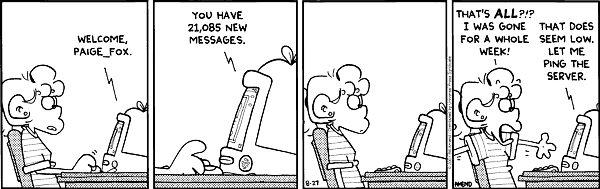
In a typical year, I receive approximately 20,000 email messages after spam-filtering has removed most of the junk. Since most messages arrive outside of weekends and holidays, this translates to a figure approaching 85 emails per weekday. Liberally estimating that 15-20 of these are announcements, automated output (e.g., cron jobs), and unfiltered spam, I'm left with approximately 65-70 legitimate messages that request some action, often requiring a response. In an uninterrupted session, each email message I send takes an average of 10 minutes of my time. You do the math.
Bottom line: I cannot read every message I receive, and many emails that are deserving of a response will fall through the cracks. This is especially the case for expressions of interest in pursuing graduate studies in my lab. If your message is important, flag it as such in the subject line, and I'll do my best to respond if I can, but within the limits of what is feasible while trying to stay healthy. If you haven't received a reply, this does not mean I don't value your communication, but am simply overwhelmed, and this is my coping mechanism.
Further useful advice: employ an appropriate level of formality in your communications. If you wouldn't feel it appropriate to address someone face-to-face with "Hey", then it's probably not the best choice of greeting for an email either. Unless you're trying to be ignored.
When I originally wrote this page at the beginning of the millennium, I referred with dismay to the all-too-common lineup for Internet access at academic conferences. This, of course, was soon supplanted by eyeballs glued to smartphones and tablets. Time marches on, but the all-consuming power of email (and texts, tweets, Facebook and Instagram posts, Slack, Signal, Discord, etc.) continues unabated. People check their devices constantly throughout the day, interrupting whatever they're doing at the beep or buzz of each new incoming communication — a habit reinforced by senders who now expect a reply within minutes, if not sooner.
Naively, I thought I could beat the pressure, and so tried to adhere to a policy of checking my incoming email at most once per day, usually in the evening, and then turning it off. Unfortunately, I wasn't strong enough. The policy didn't survive contact with reality. As I later learned, the same was true even for those tech leaders who were themselves engineering the tools of Internet addiction!
Such addiction isn't just a problem related to social media or online gaming; it applies equally to all forms of electronic communications, compounded by the same brain-rewiring mechanisms of intermittent variable rewards (the Hook model) that are employed by tech companies to keep eyeballs on the screen. Exacerbating the problem, frequent interruptions from notifications of any form break our flow of thought, undermine sustained and focused attention, and so affect our cognitive processing — and thus human intelligence — in profound ways, as described in the study on attention hijacking by Fournier et al. in Computers in Human Behavior — see Hendrick's substack article for a good synopsis.
Although we are seeing progress in legislation with respect to combating video game addiction in at least one country, and more recently, instituting social media use age restrictions, even in Canada, can we realistically expect governments to consider similar laws requiring notifications to be disabled, at least by default, so that we have a chance to make our own decisions as to when we will be interrupted? I would wager against this. Thus it's up to individuals — yes, that means turning off notifications yourself — to take back some control over our technology, as advocated years earlier, and popularized by Tristan Harris.
Last updated on 8 July 2026
by Jeremy Cooperstock